

Why Is A7A5’s Trading Activity Being Challenged?
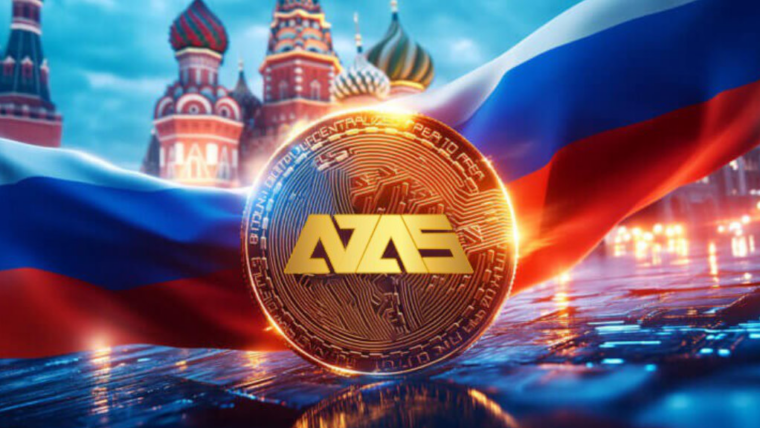
A dispute is widening between A7A5, a sanctioned ruble-backed stablecoin issuer, and blockchain analytics firms over how much of the token’s reported activity reflects genuine market usage.
A7A5, a Russian cross-border stablecoin designed to support payments outside Western financial channels, says it averages about $205 million in daily trading volume and processed $34.4 billion between Jan. 1 and June 17 this year.
Oleg Ogienko, A7A5’s director for regulatory affairs, said most of the token’s activity takes place in decentralized finance. In that environment, users can trade directly between wallets, often without the identity checks required by centralized exchanges. That makes DeFi a natural venue for activity that does not appear fully on mainstream exchange data platforms.
Blockchain analytics firms are challenging that explanation. TRM Labs analyst Chris Keegan said the firm’s analysis places A7A5’s average daily volume closer to $75 million, with activity declining in recent months. He also said about 34% of observed transaction volume appears to involve circular fund movements that may inflate activity.
“We truly don’t think there is large-scale, authentic usage of A7A5 outside of A7,” Keegan said, referring to the token’s issuer.
What Does The Volume Dispute Reveal About DeFi Data?
The disagreement highlights a basic problem in crypto market surveillance: DeFi activity can be visible on-chain but still difficult to classify. A transfer between wallets may represent a real payment, internal treasury activity, market making, wash-like activity, or circular movement. Without clear information about counterparties and intent, volume can be measured but not always understood.
That issue becomes more sensitive when the token is linked to sanctions evasion. A7A5 is backed by deposits at Promsvyazbank, a Russian bank under Western sanctions, and was rolled out in Kyrgyzstan in early 2025. Western authorities have also sanctioned A7A5, citing its alleged role in helping Russia move value outside traditional financial channels.
Ogienko rejected the analytics firms’ conclusions and argued that existing market data tools fail to capture the token’s DeFi-heavy activity. “These outdated principles and metrics do not provide users around the world with objective information about A7A5,” he said.
He also said major data providers rely too heavily on centralized exchange data, creating what he called “a generally discriminatory approach, contrary to the principles of the United Nations.”
Investor Takeaway
The dispute shows why reported crypto volume can be especially unreliable for sanctioned assets. On-chain activity may be high, but investors and compliance teams still need to distinguish real external demand from internal transfers, circular flows, and exchange-linked liquidity patterns.
Are Sanctions Limiting A7A5’s Reach?
Elliptic co-founder Tom Robinson said A7A5 has lost momentum, with monthly transaction volumes down more than 90% since January and 96% below their peak last year. He linked the decline to sanctions imposed by the U.S., the European Union, and the United Kingdom, as well as the collapse of the Russia-linked exchange Grinex earlier this year.
“The cherry-picked trading and transaction figures provided by A7A5 are consistent with Elliptic’s analysis,” Robinson said. “However, they conceal the obvious trend: that A7A5 is failing in its goal of enabling Russian sanctions evasion.”
That interpretation points to a key pressure on sanctioned stablecoins. Even if a token can move on-chain, its usefulness depends on liquidity, counterparties, listings, and conversion routes into other assets. Western sanctions can limit access to global trading venues and discourage exchanges, market makers, payment firms, and custodians from supporting the asset.
Kaitlin Martin, a sanctions and national security specialist, said A7A5 remains largely confined to a Russia-linked ecosystem because sanctions have prevented most global trading venues from listing it. That does not make the token irrelevant, but it narrows its path to scale.
What Are The Cross-Border Payment Risks?
A7A5’s main risk is not only its reported volume. It is the possibility that sanctioned users can still swap the token into other cryptocurrencies through Russia-linked services and then move funds into the wider crypto ecosystem. That can support cross-border payments, including trade tied to commodities and other hard-to-monitor sectors.
The token’s structure makes it important for regulators. A ruble-pegged stablecoin backed by a sanctioned Russian bank is not simply another local currency token. It is part of a broader contest over whether crypto rails can weaken Western financial restrictions when banks, correspondent networks, and centralized exchanges are closed off.
Russia’s recent sanctions against British teenager Alexander Browder added a political layer to the issue. Browder had written a report for The Henry Jackson Society alleging that A7A5 was used to help fund Russia’s war effort against Ukraine. Russia’s Foreign Ministry accused him of spreading “defamatory speculations and false information.”
For investors, exchanges, and compliance teams, the A7A5 dispute shows how difficult it is to assess sanctioned crypto assets using ordinary market metrics. Daily volume, total processed value, and DeFi activity can all tell part of the story, but none of them alone can prove broad adoption or effective sanctions evasion.
The larger issue is that crypto activity outside centralized exchanges is harder to measure, harder to attribute, and harder to regulate. A7A5 may be a limited asset within a Russia-linked network, or it may remain a useful bridge into wider crypto liquidity. The disagreement over its data shows why that distinction is now a sanctions enforcement problem, not just a market data problem.
