

Why Is MetaMask Adding A Yield-Bearing Account?
MetaMask has launched Money Account, a self-custodial wallet feature that allows users to earn returns on stablecoin balances while keeping those funds connected to spending, trading, and other onchain services.
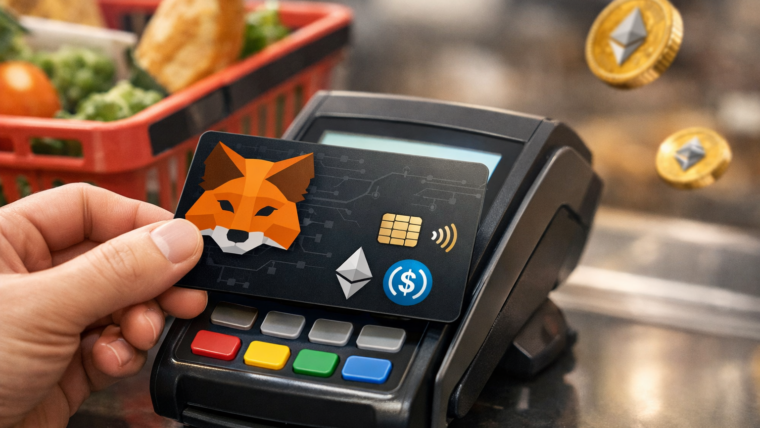
The product is designed to turn idle stablecoin holdings into a more active financial balance. Users can deposit mUSD, MetaMask’s native stablecoin, and earn up to 4% variable APY without staking, lock-ups, or manual yield management. The account is also connected to MetaMask Card, a Mastercard-powered product that lets users spend from the same balance.
The launch reflects a broader shift in crypto wallets. Self-custody products are no longer being built only around storage and token swaps. They are moving closer to bank-like account functions, combining yield, payments, stablecoin conversion, and investment access inside one interface.
That matters for MetaMask because the wallet already sits at the center of many Ethereum-based user flows. If users can earn yield, spend, trade, and access onchain services without moving funds to a separate exchange or lending platform, the wallet becomes a more permanent financial account rather than a pass-through tool.
How Does Money Account Work?
Money Account will initially generate yield through DeFi vaults on Morpho, with plans to expand to Aave. Veda built the vault infrastructure, while Steakhouse Financial is serving as risk curator.
The product uses mUSD as the core balance. Supported stablecoins, including USDC, USDT, DAI, aUSDC, aUSDT, and aDAI, can be converted into mUSD at 1:1 parity with no conversion fees on supported chains. Users can also purchase mUSD through debit card, credit card, or Apple Pay.
mUSD launched in September 2025 and is issued on Ethereum and Consensys’ Linea Layer 2. The stablecoin currently has a market capitalization of about $32 million, after briefly rising above $100 million shortly after launch.
The account is also connected to MetaMask’s wider product suite, including swaps, perpetuals, prediction markets, and card spending. That structure reduces the need for users to move stablecoins across different platforms for different purposes.
Investor Takeaway
MetaMask is trying to make stablecoin balances stickier. By linking yield, spending, and onchain access inside the same wallet, the product could reduce liquidity fragmentation and increase the role of self-custodial wallets in daily crypto finance.
Why Did MetaMask Choose Monad As Its Home Chain?
MetaMask has tapped Monad as the home chain for Money Account. Monad is a fully EVM-compatible Layer 1 blockchain designed to support Ethereum-like smart contracts while offering high throughput, fast block times, sub-second finality, and low fees.
The choice is important because consumer financial products need low-cost and fast transaction environments if they are expected to support regular activity. A yield-bearing account connected to spending cannot rely on expensive or slow settlement if it is meant to compete with a normal fintech account experience.
Monad launched in November 2025 and is positioning itself as a performance-focused chain for Ethereum-compatible applications. For MetaMask, using Monad gives the wallet a dedicated execution environment for a consumer-facing stablecoin product while still staying within an EVM-compatible framework.
Monad Foundation co-founder Keone Hon framed the product as a step toward consumer stablecoin adoption. “This is what consumer stablecoin adoption at scale looks like: a product built for daily spend, with savings and yield integrated and the complexity handled under the hood,” he said.
What Does This Mean For Stablecoin Competition?
The launch comes as stablecoin balances are increasingly being turned into yield-bearing products. Tokenized funds, DeFi vaults, and wallet-native accounts are all competing to make stablecoins more useful than simple cash substitutes.
For users, the appeal is clear: stablecoins can become spending balances, savings balances, trading collateral, and onchain liquidity at the same time. For platforms, the commercial incentive is also clear. The more use cases attached to a stablecoin, the less likely users are to move funds elsewhere.
MetaMask’s advantage is distribution. As one of the most widely used Ethereum-centered wallets, it already has access to users who hold stablecoins, trade tokens, interact with DeFi, and manage self-custody. Money Account attempts to pull those behaviors into one account structure.
Consensys CEO Joe Lubin described the product as a response to fragmented user behavior. “For too long, the crypto experience has been fragmented; one place to trade, another to earn, another to spend,” he said. “People build their wealth inside MetaMask, but until now they couldn’t keep it working here.”
Investor Takeaway
The product increases competition between wallets, exchanges, DeFi protocols, and tokenized cash products. The winner may not be the platform with the highest yield, but the one that makes stablecoin balances easiest to earn on, spend, and reuse across crypto markets.
How Far Is MetaMask Moving Beyond Wallet Infrastructure?
Money Account is part of a wider product push from MetaMask. The wallet has expanded beyond Ethereum by adding native integrations for Solana and Bitcoin, and Consensys has previously confirmed plans for a MASK token.
The company has also been adding more consumer and market-facing services. Recent releases include an Agent Wallet feature that gives AI agents access to Ethereum, along with integrations for tokenized U.S. stocks, ETFs, and commodities through Ondo Global Markets.
Those moves show that MetaMask is becoming less of a single-purpose wallet and more of a financial operating layer for crypto users. Money Account extends that strategy by making stablecoin balances productive without sending users outside the wallet.
The main question is risk. Yield still comes from DeFi infrastructure, and users will need to understand that variable APY, vault design, curator oversight, and smart contract exposure are different from a bank deposit. For MetaMask, the challenge is to make the product simple without making the underlying risk feel invisible.
If adoption grows, Money Account could become a test case for the next stage of stablecoin finance: self-custodial accounts that combine savings, payments, trading, and onchain access inside one wallet. That would move wallets deeper into the territory traditionally occupied by banks, brokers, and fintech apps.
