

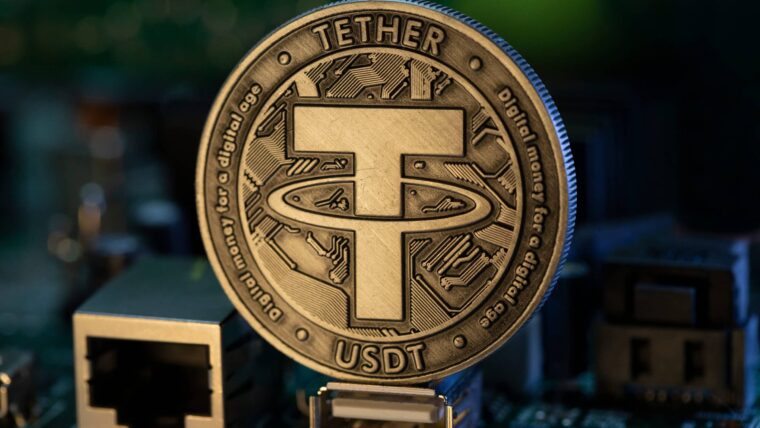
Why Did USDt Move Ahead of Ether?
Tether’s USDt has become the second-largest cryptocurrency by market capitalization after Ether fell to its lowest price of the year on Friday, marking a symbolic shift in a market increasingly favoring liquidity and stability over volatile network tokens.
Ether’s market capitalization dropped below $185 billion after a 5.2% decline over 24 hours, with the asset falling to $1,510 on Coinbase, according to TradingView data. USDt, with a market capitalization of about $186 billion, moved ahead of Ether as the largest stablecoin continued to expand while ETH weakened.
The flip does not mean stablecoins have replaced smart contract platforms as the center of crypto activity. It does show that stablecoins are now one of the strongest structural demand areas in the market. During periods of volatility, traders, exchanges, payment firms, and decentralized finance users often move into dollar-linked tokens rather than exit crypto rails entirely.
“[The] stablecoin overtake really highlights how the market still favors stability over ETH’s volatility right now,” Andri Fauzan Adziima, research lead at Bitrue Research Institute, said.
What Does The Shift Say About Stablecoin Demand?
The development reflects the growing role of stablecoins as a core part of the crypto market structure. Stablecoins now represent almost 15% of total crypto market capitalization, a level that shows demand is no longer limited to trading during risk-off periods.
In the last bear market, stablecoin supply contracted by more than 30%. This cycle has been different. Stablecoin supply has continued to reach record highs even as major crypto assets have struggled. That resilience suggests that stablecoins are being used not only as a temporary shelter from volatility but also as settlement assets, exchange liquidity, payment rails, and dollar access tools.
Alvin Kan, chief operating officer of Bitget Wallet, described the flip as a “notable milestone that highlights the explosive growth and dominance of stablecoins in today’s crypto ecosystem.”
“It demonstrates strong demand for reliable, liquid on- and off-ramps during periods of volatility, while serving as a reminder that ETH must continue delivering compelling utility and narrative momentum to maintain its position,” Kan said.
Investor Takeaway
USDt overtaking Ether is a market-structure event rather than only a price-ranking change. Stablecoins are absorbing demand because they offer liquidity, dollar exposure, and settlement utility at a time when volatile crypto assets are struggling to hold support.
Why Is Ether Under Pressure?
Ether’s decline has returned the asset to long-term support levels last seen in October 2023 and April 2025. The price weakness has left Ethereum exposed to a more difficult comparison with stablecoins, whose value does not depend on network revenue expectations, investor appetite for risk, or the broader smart contract narrative.
The Ethereum ecosystem has also faced internal pressure. Recent developments include several executive departures and a 20% workforce reduction at the Ethereum Foundation. Those changes have added to concerns about Ethereum’s direction at a time when investors are already questioning whether ETH can regain momentum against competing layer-1 networks, bitcoin, and stablecoin-led liquidity flows.
At the same time, the ecosystem is not standing still. A new nonprofit organization called Ethlabs was launched this week by key Ethereum Foundation developers and researchers, with backing from Ether treasury firms Bitmine and Sharplink. The move suggests that parts of the Ethereum developer and treasury ecosystem are trying to rebuild momentum even as the token trades near critical support.
The challenge for ETH is that market leadership now requires more than being the default smart contract asset. Investors are looking for clearer utility, stronger fee demand, institutional accumulation, and a narrative that can compete with bitcoin’s store-of-value role and stablecoins’ settlement role.
Are Investors Treating Ether’s Drop As An Opportunity?
Not all market participants are turning bearish on Ether. Some treasury-focused investors have used the decline to add exposure. Sharplink bought 5,000 ETH on Thursday, its first purchase in 8 months. Bitmine, chaired by Tom Lee, also continued accumulating at lower prices, adding 76,881 ETH last week.
Those purchases show that parts of the institutional and treasury market still view Ether’s decline as an accumulation window rather than a structural exit. The question is whether that demand is large enough to offset weaker market sentiment and the growing preference for stablecoin liquidity.
The broader ranking shift was not limited to Ether. Circle’s USDC also overtook XRP by market capitalization as XRP fell back toward $1, its lowest level since November 2024. XRP’s market value declined to about $64 billion, compared with USDC at $73.6 billion.
Together, the moves show how stablecoins are gaining relative weight across the crypto market. Their rise is not driven by speculative upside, but by their role as liquid dollar instruments inside crypto trading, payments, and DeFi. For Ether, the message is more direct: ETH must defend both price support and its investment narrative while stablecoins continue to capture demand through utility rather than volatility.
