

Why Is Bitcoin Insurance Becoming More Relevant?
Bitcoin self-custody has always carried a simple trade-off. Holders gain direct control over their assets, but they also take on the risks that banks, custodians, and brokers normally absorb. Lost seed phrases, damaged backups, home theft, fire, water damage, and physical coercion can turn personal custody into a high-value security problem.
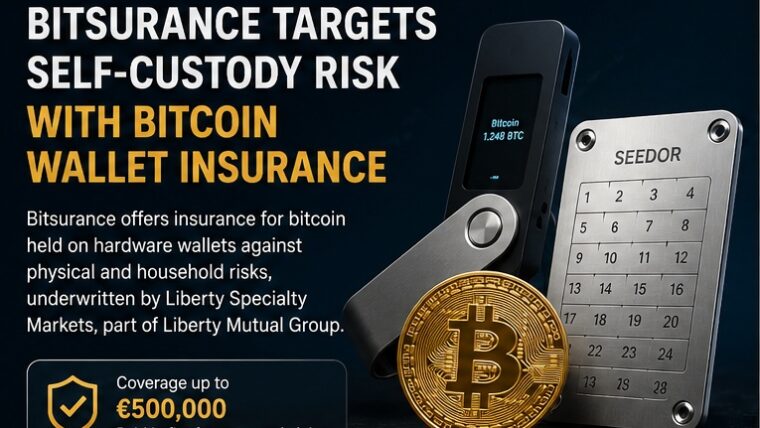
Bitsurance is trying to address that gap by offering insurance for bitcoin held on hardware wallets. The company, co-founded and led by Chris Seedor, covers risks including fire, flooding, robbery, and physical attacks, with policies underwritten by Liberty Specialty Markets, part of Liberty Mutual Group.
The product arrives as bitcoin holders increasingly split between institutional custody and private storage. Spot ETF adoption has made regulated exposure easier, but many long-term holders still prefer to control their own keys. That creates a market for services built around the weak points of self-custody rather than price speculation.
Seedor’s own history gives the business a personal angle. In 2011, he spent nearly 1,500 BTC on a graphics card. At today’s prices, that bitcoin would be worth more than $90 million.
How Did A Lost Bitcoin Fortune Shape The Business?
Seedor said a friend gave him bitcoin while he was a university student, when the asset was still widely viewed as experimental and had little practical use for most people.
“He gave me tons and tons of free Bitcoin,” Seedor said. “I didn’t see any use for it because I live in Germany and PayPal is a thing and I didn’t have a drug habit or something.”
He later described the graphics card purchase as one of the most expensive hardware transactions in bitcoin history. “I famously own the most expensive graphics card in the world,” Seedor said. “I bought a graphics card for a little less than 1,500 bitcoin in 2011.”
That early experience did not push Seedor away from bitcoin. Instead, he became more focused on the security problems surrounding long-term storage. A mechanical engineer by background, he designed a stainless steel seed phrase backup called the Seedor wallet. Over more than 6 years, the project developed into a business focused on protecting bitcoin holders from physical and operational failure.
Seedor calls the steel backup he created “the most primitive form to store the most advanced sound money.”
Investor Takeaway
Bitsurance reflects a maturing bitcoin market where infrastructure is expanding beyond trading, custody, and ETFs. As more wealth moves into self-custody, physical security, backup durability, and insurance coverage are becoming part of the investment stack.
What Risks Does Bitsurance Cover?
Bitsurance insures bitcoin held on hardware wallets against physical and household risks that are difficult for holders to hedge on their own. Coverage includes fire, water damage, robbery, and violent coercion, including what the crypto industry often calls the “$5 wrench attack.”
That term refers to a simple but serious threat: an attacker using physical force or intimidation to make a holder give up access to their wallet. For self-custody users, this risk sits outside normal cybersecurity tools. A strong password, a hardware wallet, or a steel backup may not help if the attack targets the person rather than the device.
“I always had this fear of the $5 wrench attack,” Seedor said. “What if somebody comes to my house, kicks my door and threatens me or my family? What do I do in that scenario?”
The concern has become more visible after violent incidents involving crypto holders in Europe. Seedor pointed to attacks in France, including a kidnapping attempt targeting the wife of Sebastien Borget, co-founder of Ethereum-based virtual world The Sandbox.
Bitsurance policies compensate customers in fiat if a covered bitcoin loss claim is approved. Seedor said the company offers coverage of up to €500,000.
What Does This Mean For Bitcoin Custody?
The emergence of bitcoin insurance highlights a broader change in how the market views custody. In earlier cycles, the main question was whether investors trusted exchanges or preferred self-custody. Today, the custody discussion is more layered. Investors must weigh convenience, counterparty risk, physical security, legal protection, recoverability, and insurance coverage.
For institutional users, insurance is already part of custody selection. For retail and high-net-worth self-custody holders, coverage has been less developed, even though the risks can be severe. A hardware wallet can reduce exchange risk, but it cannot remove the danger of loss, theft, or physical damage.
Bitsurance is targeting that unresolved space. Its partnership with a major insurance underwriter gives the product a traditional financial layer around an asset class built on personal control. That structure may appeal to bitcoin holders who want self-custody without leaving every operational risk on their own balance sheet.
The business also shows how bitcoin’s market infrastructure is shifting from growth-first products to protection-focused services. As holdings become larger and more long-term, investors are likely to demand tools that look less like crypto-native speculation and more like wealth preservation.
For bitcoin adoption, that is an important step. A market where holders can insure private storage against real-world risks is a market moving closer to conventional financial infrastructure, even while preserving the self-custody model that made bitcoin distinct in the first place.
