

What Drove Galaxy’s First-Quarter Loss?
Galaxy Digital reported a $216 million net loss in the first quarter of 2026, as a broad decline in crypto prices weighed on its balance sheet and investment portfolio.
The total crypto market capitalization fell about 21% خلال the quarter, leading to unrealized losses across the firm’s treasury holdings and venture investments. The drawdown reflects continued sensitivity of crypto-native balance sheets to market cycles.
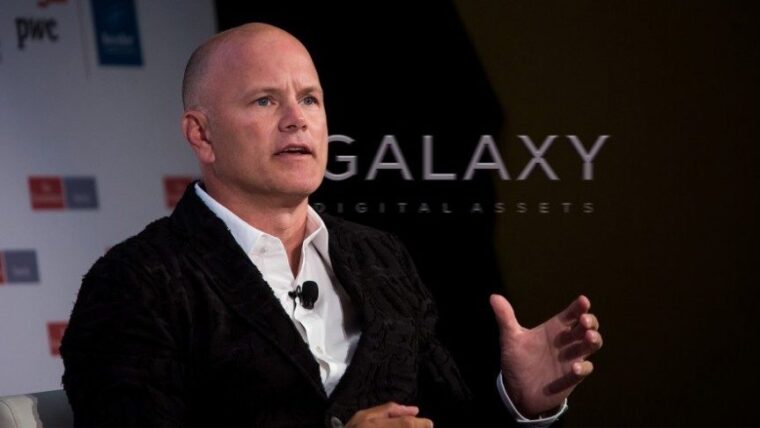
Despite the losses, CEO Mike Novogratz framed the period as part of a structural transition in the industry. “For digital assets, this is a transition year — globally, we’re moving from a speculative asset class, the ‘crypto casino,’ some would call it, to a technology that will be embedded across industries worldwide,” he said during the earnings call.
Is Galaxy’s Trading Business Decoupling From Crypto Prices?
Trading volumes held mostly steady during the quarter, even as the broader market declined. Galaxy reported flat activity levels, which Novogratz described as an early sign of reduced dependence on price movements.
“The first time we’ve really started to see a decoupling of our business from the price,” he said, pointing to more stable client activity despite volatility.
The Digital Assets segment generated $49 million in adjusted gross profit, slightly below the $51 million recorded in the previous quarter. While modest, the consistency suggests that trading and execution revenues are becoming less tied to directional market moves.
Investor Takeaway
Why Is the Data Center Business Becoming Central?
Galaxy is increasingly leaning on its data center segment to offset crypto market volatility. The company recently delivered its first data hall at the Helios campus in West Texas under a lease agreement with CoreWeave.
The full buildout of the site is expected to generate more than $1 billion in annual revenue, positioning the business as a large-scale infrastructure play tied to demand for compute and artificial intelligence workloads.
Executives described the milestone as “the single most important de-risking event this business has experienced,” highlighting its role in diversifying revenue away from crypto price exposure.
Revenue from the data center segment is expected to begin ramping in the second quarter, marking a potential inflection point for the company’s earnings profile.
Investor Takeaway
What Is the Long-Term Strategy for Growth?
Beyond trading and infrastructure, Galaxy pointed to rising institutional demand for blockchain-based financial services, including custody, trading, and tokenization.
Executives said that over time, performance should depend more on platform usage than on market direction, as capital markets infrastructure evolves.
Novogratz also highlighted the broader shift underway in financial systems, stating that “the entirety of the capital markets … ultimately needs to be rewired.”
The strategy reflects a move toward positioning Galaxy as a full-stack digital asset and infrastructure provider, rather than a firm primarily exposed to crypto price cycles.
